

Baseball Doesn’t Forget
The Timeless Loop of Baseball’s Taste for Revenge


One day, when I was playing for Texas, our third base coach, Steve Smith, was throwing batting practice in Oakland before a game. Smitty was not the ideal batting practice pitcher. His delivery was funky, and the natural movement of his pitches made him release sliders when hitters were looking for straight, easy-to-hit pitches. Before a game, hitters want as little movement on those pitches as possible, ideally something like a machine at a local batting cage.
On this particular day, in addition to the usual unpredictable movement on his pitches, Smitty’s control was a bit off. Eventually, disaster nearly struck when he hit me on the bill of my helmet. As you might imagine, taking out one of your own players during pre-game warmup routines is not exactly sound strategy. I was fine, but it was jarring. Someone in our group called out, “Well, you could at least apologize.”
Smitty’s response? “I would apologize, but I didn’t do it on purpose.”
I moved on quickly enough, though I was a little more alert and ready to duck out of the way.
Baseball is played in a series. You do not just play a team once; you play them multiple times in a row. So the next day, it is the same stadium, same routine. Batting practice again in Oakland. I chalked up the helmet incident from the day before to a one-time thing. But then a new concern presented itself.
Smitty was not using the L-screen, the protective net meant to shield BP pitchers, properly. He was leaving part of his body exposed after every pitch.
Throwing BP to big league hitters means one thing. You are serving up meatballs. It is about giving them pitches they can hammer. Rockets flying all over the field. On one hand, you are feeding the confidence of already confident hitters. On the other hand, you are putting your life in danger every time someone hits a line drive. The ball can come off the bat at 100 mph, and your only defense is the netting on that L-shaped screen that sits between you and the batter.
You are also navigating a laundry list of objectives that each hitter is bringing to the batter’s box. Hitters are always working on something, filmed from every angle. It forces you to be adaptable and throw a pitch exactly where the hitter wants it. This goes on for 40 minutes to an hour every day with multiple BP pitchers, either in the cage or on the field, weather permitting.
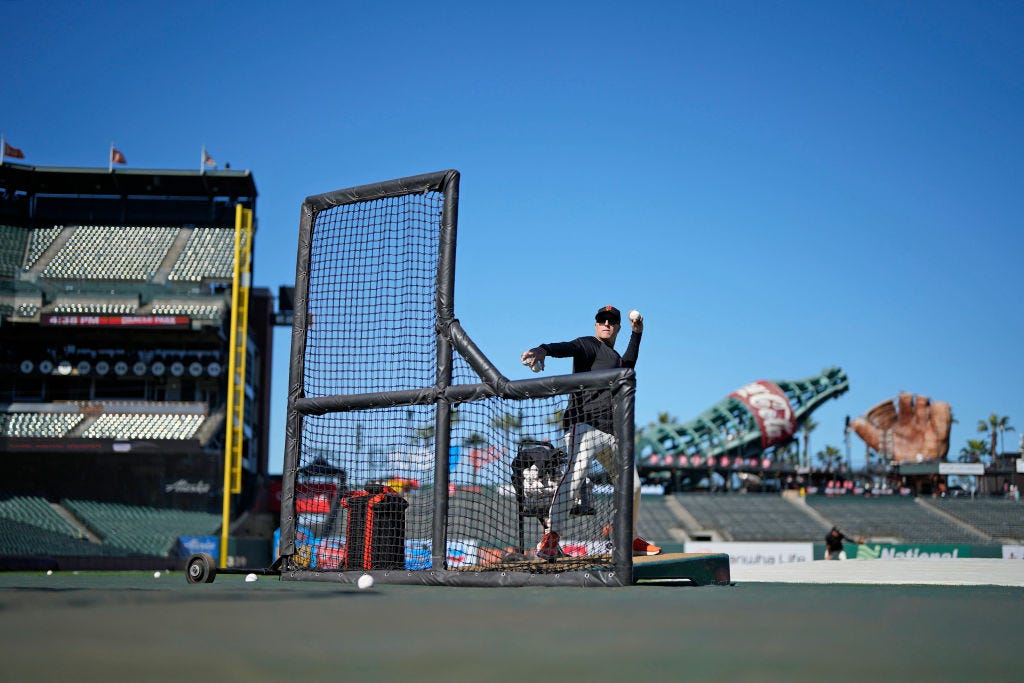
Through all of it, there is one non-negotiable about the job: focus. As a batting practice pitcher you must be locked in to avoid hitting one of these very expensive players and to protect yourself from being in the way of a hit. Reflexes help, but are secondary to positioning yourself behind that L-screen.
But Smitty had his own technique. Instead of ducking behind the tallest part of the net after each pitch, he would throw the ball, turn his back to the batter, and bend at the waist, like one of those wooden ducks dipping in the water at a carnival. We kept warning him. From every angle, we could see it as clear as day. He was leaving himself exposed to a hard hit ball far too long after each throw.
Most BP pitchers understand the hazard and do what they can to stay protected behind that screen. We would continue to call out to Smitty and remind him to get behind the screen. Smitty had been lucky for a long time, and he seemed content with his mallard duck routine. But, it looked anything but safe.
Baseball has a way of restoring balance. It is a game built on equilibrium and karma. You win one, you lose one. You get’em today, or you get’em tomorrow. Someone hits a batter intentionally one day? You face off again, and you hit them back. It might be the next day, next week, next season, or even five years from now.
It is a game of elephant-like memory. You have to remember patterns, smells, and the feel of the batter’s box in Fenway. And sometimes you just cannot forget, especially when it comes to a grudge.
Now, I did not go to bed the night Smitty dinged me in the helmet thinking I needed to get back at him. I did not think he deserved any form of retaliation. It was an accident. But that is the thing about baseball, sometimes vengeance is not planned or malicious. Sometimes, it is an innocent, natural consequence. A byproduct of finding yourself in a familiar moment, only this time with the chance for a different outcome. A bit of déjà vu that circles around in your head, beyond your control, with no clear premonition of how the moment might play out.
You feel it on the back of your neck. The tingle of recognition. A hotel room number. The taste of a burger. The glare of sunlight hitting the outfield light tower at just the right angle.
That is baseball’s rhythm. Playing 162-plus games a year, going day after day, sometimes it feels like you are in a loop. You train through repetition. You stick to your routines, often to a fault. But you go down on our own terms, stubborn, maybe, but authentically so.
So the next day, I found myself in that loop. Same stadium. Same batting practice. Same batter’s box. Smitty throwing again. I was back on the merry-go-round. Everything aligned. Twenty-four hours had passed, but it felt like the same moment.
Then it happened. Smitty wound up and tossed another non-straight pitch, maybe a cutter, maybe a sinker, but it came right into my wheelhouse. I took my normal swing and absolutely smoked it right back up the middle.
Immediately I knew it was trouble.
Smitty began his three-step dodgeball dance. Step one, throw the pitch. Step two, turn his back. Step three, bend at the waist. His so-called system, based on the wildly mistaken idea that he could somehow dodge a 100-mph missile if he did not look at it.
But, just as he turned, right before the duck, the ball I hit drilled him square on the back-top of his head and ricocheted into center field.
It was like the vinyl record of baseball skipped. And skipped again.
Smitty froze. He slowly dropped to one knee, like he was afraid that if he moved too quickly, a patch of hair imprinted with the smoking seams of a baseball might slide off of his head with the impact. He stayed bent at the waist, stuck in that ducking position, in some kind of suspended animation.
We rushed over, unsure of how to react. Luckily, he was more stunned and angry than injured. But it was terrifying for a moment. The horror was real, but as time went on, knowing he was okay allowed us to see the irony of the moment. We were swimming in that weird place between concern and comedy where guilt bubbles up.
Once the dust settled and Smitty was himself again, the baseball karma machine whispered that the moment was ready. It was time to complete the circle and the time was indeed right.
So I looked at him, smiled wryly, and said, “I would apologize, but I didn’t do it on purpose.”
Share your thoughts!
Have you ever experienced a moment where "karma" seemed to come full circle?
Killer callback on that punchline! Revenge is a dish best (accidently) served with a line drive up the middle.
Reminds me of a spring training bp session in Tucson. Might have been the first day pitchers were throwing to hitters. Jim Corsi, a tough veteran, got on the bump and immediately got rid of the L screen. “Don’t need this, never needed this”. Into the box steps Greg Colbrunn, for whom the fastball he couldn’t turn around has yet to be invented. Naturally, Corsi’s first pitch comes right back at him and gets him between the eyes. Over his objections, we go to the hospital to have him checked out. While he’s been hooked up, he’s trying to convince the veteran ER nurse that he’s fine and wants to back to the hotel. Finally she says, “ok, if you can stand up and take two steps maybe I’ll believe you”. Corsi stands up and promptly finds himself on the floor,from where he looks up at the nurse and says, “yeah, maybe you’re right”. P.S. he was fine after an overnight stay, but still refused to use the L screen.