

Built for Work
Luxury, Labor, and the Performance-Driven Design of Baseball Clubhouses

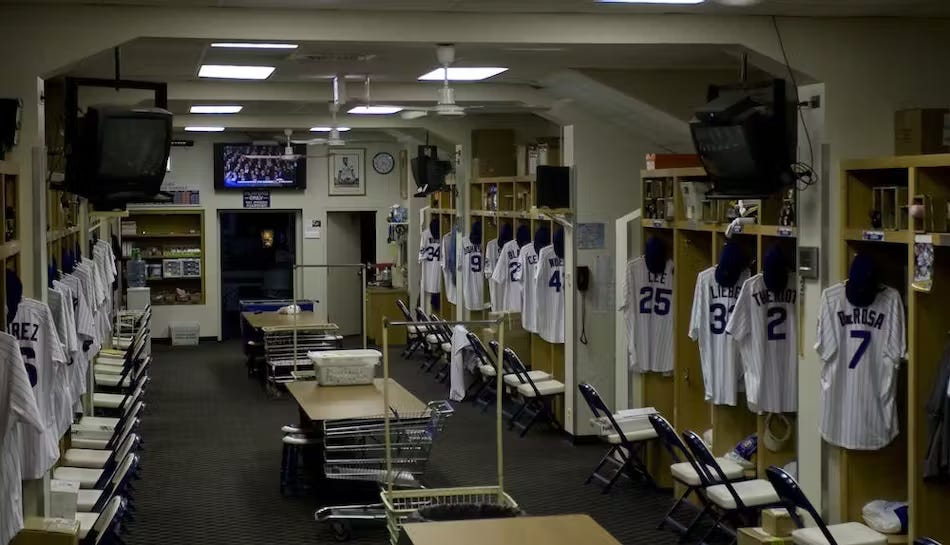
My Cubs teammate, Scott Bullett, had a hiding spot. He never revealed where it was, but whenever he needed a nap, he disappeared, only to be found when he wanted to be. Wrigley Field’s home clubhouse was not very big, so any secret nook I could imagine would have also made a great home for pigeons and squirrels. (Let’s be honest, no one has ever seen a baby pigeon.) Out of view, safe, and unreachable.
As minor leaguers in that era, we were always finding ways to maximize space. Whether we had multiple roommates or our home locker room was a trailer, we learned to be resourceful with space. Sleeping in a luggage rack during a bus ride from Huntsville to Orlando out of sheer desperation will teach you that. So, finding a hidden cave in a 100-year-old stadium? Right in our wheelhouse.
I never slept at what I considered work, even if that work was playing baseball. During my rookie and first full season with the Cubs, the coaching culture gave me the impression that sleeping at the ballpark was frowned upon. Maybe I was just trying not to rock the boat, but as a young player, I did not want to test the boundaries of clubhouse decorum. It is possible veterans had more leeway, but I was not about to find out the hard way. And back then, it was about etiquette not recovery. So having a hiding spot was never something I considered as an option. But I understood why more sleep would have helped. Cross-country flights, redeyes, endless rain delays. It all added up. Eventually, you realize recovery is not a luxury. It is part of the work required to perform.
Now, as a member of the media, I see how teams employ sleep scientists to combat jet lag and other sleep disruptions. But maybe more interestingly, hiding is easy now. Clubhouses have ballooned into mini-cities, fully stocked with everything an athlete could need.
Not long ago, we called a Cardinals-Guardians game in Cleveland. Like many teams, the Guardians recently renovated their home clubhouse. (Hot tip: Invest in companies doing these renovations. They are booming across all sports.) In their case, the Guardians absorbed the old visiting clubhouse into the new home design, creating a long, linear space that wraps around home plate. It is massive. When we asked where the new visiting clubhouse was, we were directed to the right-field corner, where a security guard was stationed. To reach him, we passed at least two other checkpoints and curved around the docking area. Halfway there, I considered calling an Uber.


Keycard locks were everywhere, which got me thinking. Who gets access to what? Can someone grab a protein bar but not get into the koi pond? Do you need clearance for the holographic hitting machine but not the planetarium? (Yes, I would vote for one, absolutely.) It would be a blast to decide who gets what level of access. What fun it must be to hold the power to grant, or deny, executive clearance.
When I played at Wrigley, the home clubhouse was tiny, but the visiting side was even smaller. In September, when rosters expanded, visiting players had to double up on lockers. Wrigley’s home clubhouse has since been fantastically upgraded (not to mention the scoreboards and other modern improvements), but there is only so much you can do with the limited visiting-side space. Still, it has come a long way.
Making it to the big leagues comes with a certain level of privilege. As high-performance athletes, we require high-performance support. Travel, training, recovery, nutrition. So when a space where we spend an inordinate amount of time is designed to enhance or maintain performance, it becomes a worthwhile investment for the organization.
With technology advancing rapidly, equipment and facilities have had to keep pace. Today’s players often work nearly around the clock before games, so naps, once something done in secret, like when Scott Bullett disappeared into his mystery spot, are more common. Especially now, with so many players arriving at the ballpark hours earlier than we did in my day.
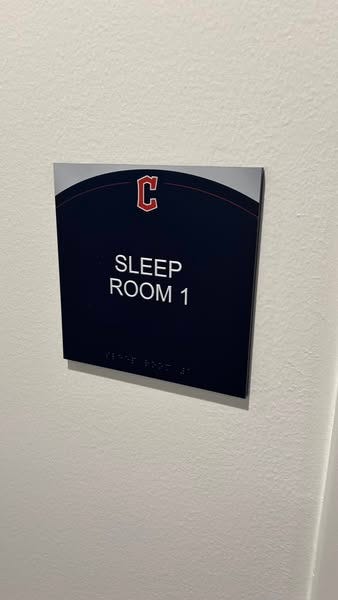
Renovations also play a role in attracting talent. It is not quite like college recruiting or the draft, but free agents still have options, and modern facilities can tip the scales. I can almost picture the press conference after signing a top free agent:
“The difference-maker for me? They have a butterfly vivarium.”
On the flip side, if your clubhouse is cramped, outdated and leaking, it will not help your case. I remember taking a cold shower as a visiting player at Fenway, a bit stunned, and thinking, Wait… does this happen on the home side, too?
From the media perspective, these new amenities can make our job trickier. We work through team PR departments to schedule interviews, but actually tracking down players in these sprawling clubhouses is another story. With so many rooms, tunnels, and quiet corners, players can quite literally vanish. Just recently, I was in the Giants’ clubhouse during the Hall of Fame induction speeches. For a brief moment, during that window when media is allowed in, I looked around and saw something I do not often have the opportunity to see as part of the broadcast team. It struck me that much of the team was gathered in the main locker area, fully engaged in the ceremony on the screen.
As a former player, I try to adjust my lens. There was a time when I stood in front of one of those lockers. But when the space changes, even if the address stays the same, it feels like one more step toward being erased. Fortunately, the Phillies’ locker room was state-of-the-art when I retired, and it still looks much the same. I can at least point to my old locker. It is still there, just with a different nameplate.


Today’s clubhouses are more than places to change into a uniform. They are cities. Complete with nutrition stations, massage rooms, recovery suites, meeting spaces, batting tunnels, lounges, and more. In the constant race to stay competitive, they have become a key battleground. The other team is always gaining on you, or pulling ahead. They might have more tools, better data, or a nicer space designed to help players digest it all. It starts to feel like home. You get there early. You stay late. Why leave when everything you need is right there? And if you win, expect a contractor in the offseason ready to redesign with that championship trophy in mind.
We all experienced significant changes during the pandemic. Baseball found a way to carry on, but the world redefined space. It became about safety. About who we chose to keep close. About the choice of being able to control or influence both.
Sport had to redefine itself and the sense of connection that is required to be a true team. You spend an excessive amount of time together during a major league season. You sacrifice intimate moments with your family to fix a hitch in your swing. You get to the park early to study your release point from every camera angle. A clubhouse is a place of business, but it is also a refuge. A sanctuary. A place you enter and do not leave until the job is done. In the interim, you must build a routine that fuels excellence and aligns with the shared purpose of everyone wearing the uniform and everyone working behind it.
These new ballparks are high-end, yes, but they serve a purpose in an insular world. It helps make up for what you lose in the other aspects of your life. Time, space, shared parenting, reliability. It is glamour, but it comes at a steep, often quietly mounting, cost.
And while it may look like excess from the outside, the truth is, this is what the job demands now. The modern athlete lives in a constant cycle of performance, recovery, preparation, and repetition. The margins are razor thin. A nap room is not just for comfort; it is about resetting your body clock after a redeye. The smoothie bar is not indulgent; it is part of recovery. The cryo chamber, the mental skills coach, the augmented reality pitching system. Each piece matters. And when the space is built with intention, it shows. Players move differently. They think more clearly. They feel supported.
And maybe, that attention to detail is the difference between winning and overindulgence.
Still, I think about Scott Bullett and his mysterious hiding spot at Wrigley. No cryo chamber, no nap pod, no biometric access required. Just a quiet corner of an old ballpark where he could disappear. In a game that demands everything from you, maybe that is all anyone is ever really looking for. A place to rest, to reset, to breathe, or simply to exhale.
Share your thoughts!
What would your dream clubhouse include for focus and performance?
What is your version of a “hiding spot” in your workplace or in life?
Another great installment. These "batting tunnels" fascinate me. Are they just about making contact, or are they narrow enough to force players to hit along a certain axis? With all the hoo-hah about shifts, how much time and energy is spent teaching players to avoid hitting the same direction every time?
I was lucky enough to have a visit (1982 I believe) with the Red Sox in the visitors clubhouse at old Cleveland Municipal Stadium. Through my starstruck eyes, it was a palace but it was probably a cramped, nails as uniform hooks dump. What really appealed to me was the buckets and buckets of bubble gum and racks of “free” chewing tobacco.
My hiding spot at work is a walk through the sage on a trail after lunch and outside of work it’s the steam and sauna rooms at the gym