

The Slump
The challenge is not avoiding slumps. It is surviving them.

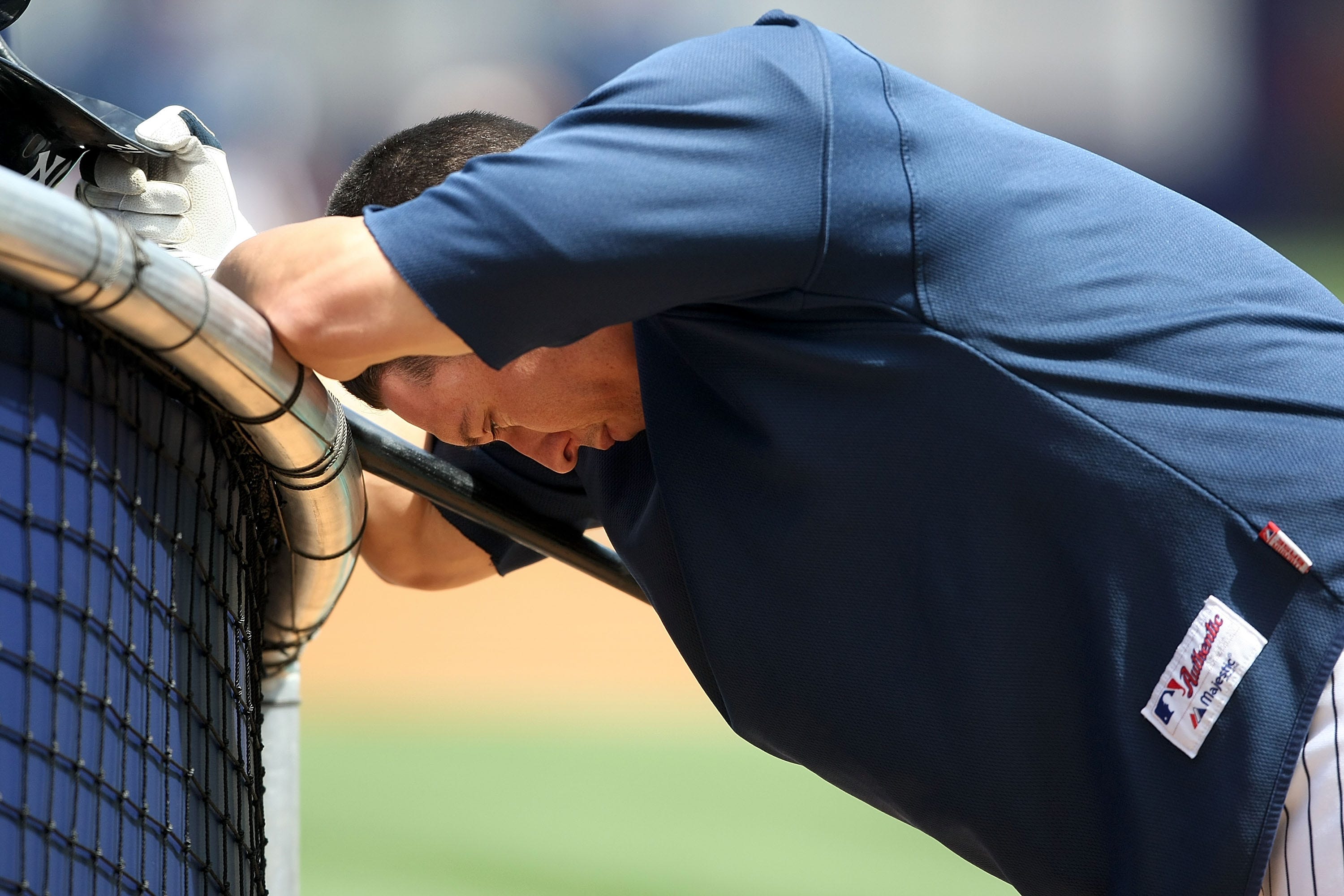
If you play baseball—if you love baseball—you are intimately familiar with the term “slump.” We can almost feel that word when we read it or say it out loud. It sounds like what it reflects: hunched over, motionless, unable to carry your own weight.
But in baseball, a slump implies a temporary state. It suggests that it will come to an end with the right approach, with the conquering of a mental army that is firing nothing but friendly fire. We are our own worst enemy. We just need to get out of our own way.
As a player, you always grapple with the possibility that this allegedly short stint may not be short at all. It could simply be who you are. That thought hits you as a young player, before you have had enough success to counter it. With time and experience, the fear changes. You worry that this could be the new normal. Age finally caught up with you. The pitchers finally figured you out. Or maybe you just do not have the edge anymore.
Recently, a fellow Substacker posted that hitters get themselves out more than pitchers do. I responded by saying, “As someone who made 2,864 outs, I concur.”
What I realized in that response is that these outs did not occur consecutively as one giant 2,864-out slump. They came between three-hit games and during 17-game hitting streaks, just as they did when I was hitless in my last 10 at-bats or during the NLDS against the Braves in 2003 when I only had one at-bat to use as evidence.
Slumps are defined by the hole you find yourself in. It is implied that they recur in some way, but there is no Webster’s Dictionary description that draws a black-and-white line around what actually constitutes a slump. Is it 20 at-bats? A month?
I found that the numbers are part of the definition, but they can also distract you from recognizing that there may be nothing particularly wrong with your mechanics. I also found that the slumps that alarmed me most were the ones I could feel. Then, upon watching the replay, I would look the part through my own professional eyes and still had no clear answers.
We cannot forget that we are operating inside the frenetic pace of a big league season, facing elite pitching every day. A train of nightmares that requires you to have an edge from beginning to end, from pitch to pitch. Then you will have a game, or a stretch of games, that matches you up against your kryptonite, something teams do far more often today than when I played. Entire organizations, teams, and pitching staffs have a plan for you. It becomes a collective assault on your weaknesses and tendencies. Today, I would probably face a bevy of sinkerballers every day, which would cause me to wake up in a cold sweat.
So you have to at least address the simpler possibilities first. Maybe you cannot see the ball well out of the pitcher’s hand. Maybe the backdrop behind him blurs your vision for some reason.
I remember playing a series at Fenway Park and not being able to hit anything. Eventually, I realized I had trouble in ballparks where the batter’s eye wall was slanted in some way. The next time through, I changed my stance and closed it off, and I ended up having one of the best series of my careers. Adjustments like that do not often work so quickly, even if those two moments were a year apart.
That is one way to reduce the duration of a slump, or reveal it to be an illusion. By making the adjustment that changes everything. You hope.
Keep in mind, there is a staff of coaches trying to help you through it. The Phillies’ hitting coach from my early days, Greg Gross, used to say that sometimes he would talk to a hitter and just go around in circles until the hitter solved his own problem, or at least believed he did. That is more than half the battle. Until you get into the batter’s box, of course.
I remember talking to Reds manager—and my former manager in Philadelphia—Terry Francona one day. Before the game, there was a parade on the field. Hundreds of kids were out there.
At one point, they formed a ring around the infield, covering every inch of dirt from line to line. Standing in the batter’s box, you could not even see the outfield grass.
Francona looked at it and quipped:
“That is what a slump looks like.”
For a moment, I just stared.
Then I realized that he had captured the best depiction of a slump in all my years of baseball.
It made perfect sense.
Even when you hit the ball on the nose, there are 18 shortstops there to gobble it up. The game feels unfair. The other team seems to know your plan before you do. It was a visual that summed up not just the concept of a slump, but nearly every interpretation of one.
No holes. No daylight. Just outs.
Because that is exactly how it feels.
Not on a stat sheet or in a box score, but in the batter’s box.
The field shrinks. The air disappears. Every defender seems to be on top of you. The holes you normally see feel sealed shut. You begin to expect the ball to find a glove before you even swing.
Despite that feeling, whether it comes in late September after 149 games played or in April during a cold snap in Chicago, you have to believe the state is temporary and that you will figure it out.
But that also requires you to be in good enough standing to have the time to work through it. If the manager runs out of patience, you may not get that opportunity. First, your season may become defined by the slump. Then, perhaps worse, you may become defined by it.
So you hope a long-term contract insulates you from losing the chance to work through it. Or maybe your status as a young first-round pick buys you time while you figure things out.
A slump requires opportunity before it starts to tell your story.
Then you begin filling in the blanks yourself.
Maybe you are getting old.
Maybe the league figured you out.
Maybe that great season was the outlier, and this is who you really are.
Maybe you are carrying something off the field. I remember struggling to focus and be productive while my father was declining and I was not home to help.
That is when the slump truly takes root. Not when you stop getting hits. When you start believing you cannot get them. Or worse, that you do not deserve to.
The home run king from a year ago is Cal Raleigh of the Mariners. Sixty home runs as a catcher—a record. One hundred twenty-five RBIs, and second in the MVP voting. Even without winning the award, he secured a place in history for producing that caliber of offensive numbers at a position that demands some of the hardest defensive responsibilities in the game. He took a beating from foul tips and wild pitches all while managing an entire pitching staff. Given the position he plays, it was one of the most remarkable seasons in baseball history.
But this season, he had been an out until an injury sidelined him.
And that is what makes slumps so humbling.
The game does not care what you did last year. It does not care that you hit 60 home runs, finished near the top of MVP voting, or put together a season that belongs in baseball history. The next pitch arrives with no memory.
A 180-degree turn from last year, and the baseball world is baffled. Even before his injury, his slump seemed chronic. It felt as though it needed a new term. One that captured both its duration and its cruel consistency. Pitchers were attacking him differently. They were making fewer mistakes, and he had yet to find an adjustment that helped. The slump had begun to feed on itself. The injury compounded it. Together, they underscore the difficult truth that greatness is not immune to the slump bug.
So it presents the age-old question:
“How do you get out of one?”
The short answer is, “I don’t know.”
The long answer is, “It varies.”
My ability to know myself helped shorten that window because, over time, I acquired various tools to deploy based on how I felt in that moment. Mechanically, I could take soft toss to make sure I stopped pulling off the ball. Mentally, I could use eye-switching so I was not overly focused on the release point. I could change my stance. I could get more rest. I could capitalize on a pitcher I hit well who was finally coming into town. I could perform rituals. Every hitter develops routines that feel like answers. Sometimes they work. Sometimes they simply buy hope for another day.
In talking to Cubs manager Craig Counsell about slumps, he explained that each player has his own way of getting out of them. With all of the analytics available today, it may be clear that there is an issue, but that is different from knowing how to resolve it.
His third baseman, Alex Bregman, leans into mechanics. He repeats drills until he unlocks the solution. In the meantime, he may stack up a few 0-for-5 games while hoping experience shortens the process, but you never really know.
In that search for answers, it is easy to become consumed by yourself. These efforts can turn into an exclusively self-absorbed exercise. You spend so much time looking for what is wrong with your swing that you forget that there is an opponent on the mound trying everything in his power to get you out. Someone with an impressive baseball résumé of his own.
I had many slumps during my career, most of which I suspect were defined by how I felt in the batter’s box. I am not sure the data would back that up by showing that I was 0-for-some-large-number. Regardless, I had to believe I would get better, lean into my routine, and live to fight another day.
That works until you run out of days, or run out of opportunity.
But until then, a slump is what you make it out to be. The more you know yourself, the more you recognize its inevitability, even its necessity.
It is part of climbing the mountain. Down to go up, up to go down.
The trick is remembering that the slump is not a verdict. It is a necessary detour from the privilege of a direct climb to the top. If you embrace it, it can be a place you are just passing through. And that perspective allows you to appreciate the view more. To appreciate reaching the summit more. To appreciate the simplicity of the air you breathe along the way.
The slump stops defining you. You define what it means.
Because every career, no matter how great, is built on outs. Thousands of them.
You just need to keep honing the tools that keep you climbing
And keep believing that you are still headed in the right direction.
Share Your Thoughts…
What is the biggest slump you've experienced in sports, work, or life, and how did you know you were finally coming out of it?
When you're struggling, what story do you find yourself telling yourself?
Is there a slump your favorite player went through that you have never been able to forget?
This speaks volumes:
So it presents the age-old question:
“How do you get out of one?”
The short answer is, “I don’t know.”
The long answer is, “It varies.”
We would have no need for creativity if we had no problems to solve. What you have stated is the essence of creativity:
"I don't know" - I have no answer. This is a problem to be solved.
"It varies" - I have to be creative. I have to create the answer anew and from scratch.
First and foremost, you have to believe in yourself. Finding an answer is not guaranteed - you may be over the hill - but until you start believing in yourself, you have lost, because you have lost the spark of creativity. When you have self-assurance you can look at the problem with an eye to the solution, just like you did at Fenway.
In my younger years, I worked as a barista. Despite pulling shot of espresso dozens of times a day for years, every once in a while there would be a day or two days in a row where my espresso was coming out wrong. Somewhere in the process of tamping the grinds in the portafilter, I was making mistakes. I always told my coworkers that my mechanics were out of order.
I always reminded myself that if baseball players, the best in the world, could go into slumps then it was okay for me, a regular guy working in a small cafe, to go into them, too.